
The Jeep built for the biggest adventures may not be the best fit for the driving you do every day. If most miles mean commuting, errands, and family trips, the Jeep Grand Cherokee vs Wrangler decision is less about which looks tougher and more about which fits your routine.
Both SUVs bring Jeep capability, but they offer different experiences behind the wheel. The Wrangler’s trail-focused design may appeal to you, while the Grand Cherokee may better suit your priorities for road travel and passenger comfort. The right choice depends on how you balance everyday ease with the capability you expect to use.
This comparison covers comfort, passenger and cargo needs, off-road interests, weather, and ownership considerations for 2026. You’ll also find practical ways to compare configurations and test-drive each SUV, so you can focus on the details that matter to your household.
Key Takeaways
- The Jeep Grand Cherokee vs Wrangler choice starts with how you’ll use your SUV most, from everyday household needs to adventure-focused driving.
- Compare cabin comfort, passenger access, and visibility in person rather than relying on broad model reputations.
- Match your off-road plans to the specific vehicle’s configuration and equipment, especially if rough trails are part of your regular routine.
- Use familiar routes during test drives to assess ride comfort, controls, and how each SUV fits your day-to-day driving.
- Review the exact vehicle and financing options at a local Jeep dealership before deciding which one feels right.
Jeep Grand Cherokee vs. Wrangler: What is the real difference?
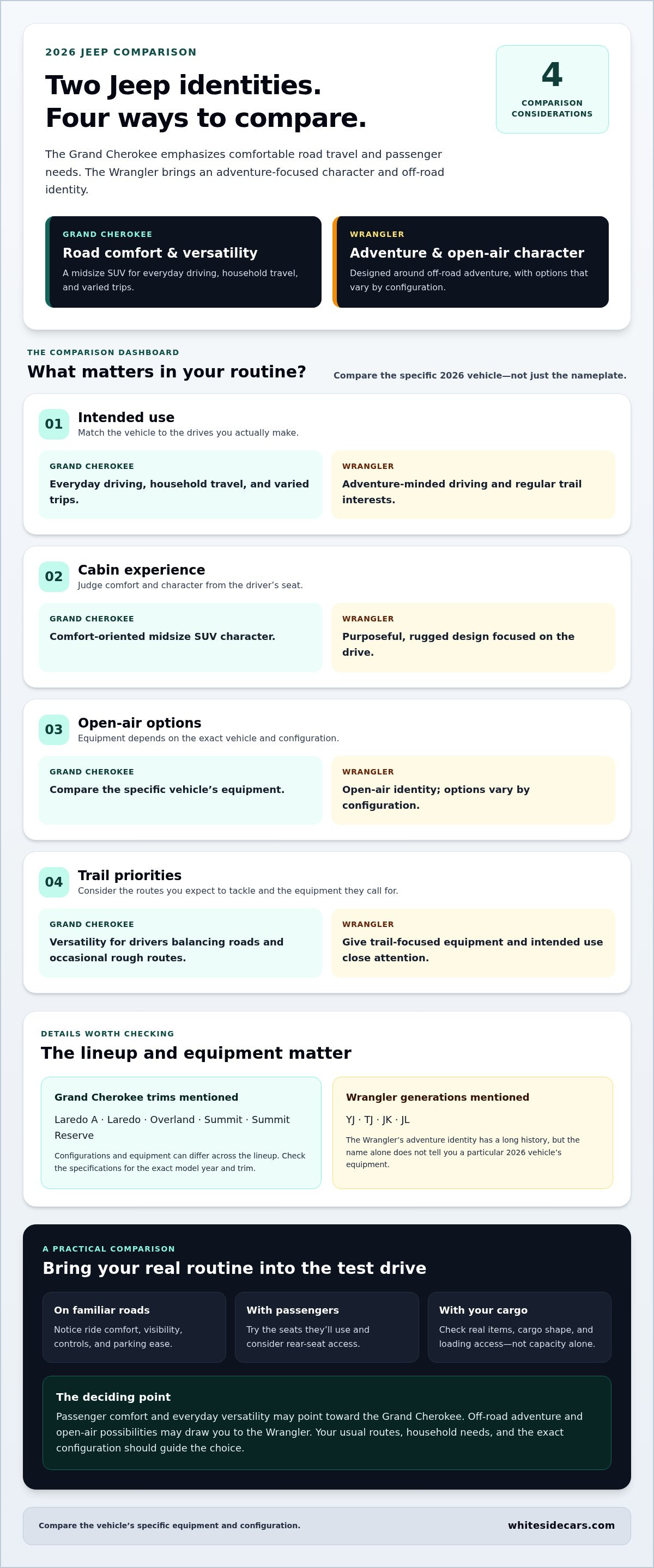
The main difference is how each SUV is designed to fit your day. The Grand Cherokee emphasizes comfortable road travel and passenger needs, while the Wrangler has an adventure-focused character and is closely associated with off-road use. Neither is the right choice for everyone. Consider your usual routes, passengers, and plans beyond paved roads to narrow down the options.
| Consideration | Grand Cherokee | Wrangler |
|---|---|---|
| Intended use | Everyday driving, household travel, and varied trips | Adventure-minded driving and regular trail interests |
| Cabin experience | Comfort-oriented midsize SUV character | Purposeful, rugged design focused on the drive |
| Open-air options | Compare the specific vehicle’s equipment | Open-air identity; options vary by configuration |
| Trail priorities | Versatility for drivers balancing roads and occasional rough routes | Trail-focused equipment and intended use deserve close attention |
What is the Grand Cherokee designed to do?
The Grand Cherokee is a midsize SUV for drivers who want a vehicle suited to regular road use and a range of other plans. Its 2026 lineup spans trims from Laredo A and Laredo to Overland, Summit, and Summit Reserve, giving shoppers different configurations to compare. Check the current specifications for the exact model year and trim you’re considering, since equipment can differ across the lineup.
Start with who rides with you and how often. If your week includes commuting, errands, and carrying passengers, pay attention to seat comfort, cabin access, and how the vehicle feels on familiar roads. A model’s reputation matters less than whether the specific configuration works for your household.
What makes the Wrangler a different kind of Jeep?
The Wrangler is known for off-road adventure and the possibility of open-air driving. Its history, including the YJ, TJ, JK, and JL generations, helps explain that enduring design focus; see this overview of Jeep Wrangler history. The name alone, however, doesn’t tell you the equipment of a particular 2026 vehicle. Trim and configuration shape what you get, including its open-air options.
Capability also depends on the Wrangler’s specific equipment and the conditions you plan to tackle. Consider whether you’ll encounter occasional rough roads or seek out trails regularly, then compare the vehicle’s equipment with those plans. A trail-oriented SUV can still serve as a daily driver, but its character may suit someone who values adventure-focused design more than a comfort-first road experience.
In short: the Grand Cherokee may suit drivers who prioritize passenger comfort and everyday versatility. The Wrangler may suit those drawn to off-road adventure and open-air possibilities. For a useful Jeep Grand Cherokee vs Wrangler comparison, let the exact 2026 configuration and your real routine guide the choice.
Compare comfort, passenger needs, and everyday driving
A vehicle that looks appealing on paper still needs to work for the drives you make most often. For commuting and errands around Columbus and nearby communities, compare how each specific 2026 Grand Cherokee or Wrangler feels in traffic, on familiar roads, and in tight parking spaces. Seating, cabin access, ride feel, and controls can vary by configuration. Use your own experience as a guide rather than assuming every vehicle in a model line drives the same way.
Which Jeep may feel better for commuting and errands?
Take both vehicles on a route that resembles your daily routine. Notice how easily you find a comfortable driving position, how much of the road you can see, and whether the controls feel intuitive. Try a few parking maneuvers, too. A vehicle’s size and sightlines can feel different from the driver’s seat than they look from outside.
Ride impressions are personal, not guarantees tied to a nameplate. Road surface, tires, trim, and configuration can all shape what you notice. A Wrangler’s adventure-focused design may involve trade-offs that matter to one commuter but not another. The useful question is whether its ride and cabin suit your priorities. Compare it directly with the Grand Cherokee rather than relying on a broad stereotype.
Which model better fits passengers and cargo?
Passenger count and access can quickly influence your decision. Think about who rides with you most often, how frequently people use the rear seats, and whether getting in and out feels straightforward. If you regularly carry children, bring a child seat to assess the fit and installation space. Have other regular passengers try the seats they’ll use instead of judging the cabin from the front row alone.
Cargo capacity figures are useful when they match the exact body style and configuration you’re considering. Even then, shape and access matter: a stroller, sports bag, or grocery load may fit differently than a published volume suggests. Bring the gear you carry often, or measure bulky items before shopping. Check how the rear opening, cargo floor, and seat arrangement work for your usual load.
- On your drive: assess visibility, ride comfort, control placement, and parking ease.
- With passengers: try the seats they’ll use and consider how often rear-seat access matters.
- With cargo: test real-life items and consider shape and loading access, not capacity alone.
A simple decision rule: If passengers and comfort shape most of your week, compare the Grand Cherokee and Wrangler in person with your household’s needs in mind. A side-by-side look at Jeep vehicles in person can make those everyday differences easier to judge.
Compare Wrangler off-road character with Grand Cherokee versatility
Start with the kind of terrain you actually expect to encounter. A gravel access road or occasional uneven driveway may call for different priorities than regular trail driving. In the Jeep Grand Cherokee vs Wrangler comparison, the useful question isn’t which model sounds more capable in general. It’s whether the specific 2026 vehicle’s equipment suits your routes, activities, and comfort preferences.
Capability isn’t determined by the model name alone. Trim, drivetrain, tires, and other equipment can affect how a vehicle is suited to different conditions. Compare specifications for the exact model year and configuration, and consider the terrain you’ll drive. Don’t assume every Wrangler has the same trail equipment or every Grand Cherokee is configured alike.
When does Wrangler capability matter most?
The Wrangler’s adventure-focused character may be especially appealing if off-pavement driving is a regular part of your plans. Think about the trails and activities you expect to pursue, then focus on relevant details such as ground clearance and the equipment included on the specific 2026 trim. Those details vary, so don’t assume advanced off-road features come standard across the lineup. Match the vehicle to the routes you’ll actually take.
When might Grand Cherokee versatility be the priority?
If your weeks combine commuting, family travel, and occasional recreation, consider how the Grand Cherokee’s available configurations fit that mix. Its 2026 lineup includes trims ranging from Laredo A and Laredo to Overland, Summit, and Summit Reserve. Compare the features and specifications of the individual vehicles you’re considering. A trim name alone doesn’t establish a vehicle’s equipment or suitability for a particular route.
Approach winter driving with the same practical care. Neither model is automatically the right choice for every Ohio winter. Weather, road conditions, tires, drivetrain, and driver habits all matter. Compare the specific vehicles’ equipment and consider where you’ll drive, from cleared suburban roads to less predictable routes. No SUV can remove the need to adapt to conditions.
| Model | Potential fit | Trade-off to consider |
|---|---|---|
| Wrangler | Drivers who expect to seek out trails and value an adventure-focused vehicle. | Decide whether that trail-oriented character fits your everyday use as well. |
| Grand Cherokee | Drivers balancing regular road use, household needs, and recreation. | Compare the exact configuration if your plans include challenging off-road routes. |
For shoppers comparing options from Mount Sterling and across the Columbus area, this Jeep dealership near Columbus guide offers local shopping context. Bring your typical driving plans to an in-person comparison, then evaluate each vehicle’s equipment against them.
Use this test-drive checklist to choose your Jeep
A thoughtful test drive turns the Jeep Grand Cherokee vs Wrangler decision into a practical comparison. Use the same steps for each 2026 vehicle and focus on how it fits your routine, not just its feature list.
- List your priorities. Write down your usual driving, passenger needs, cargo, recreation, and the conditions you encounter, including Ohio rain, winter weather, and changing road surfaces. Separate must-haves from features you may rarely use.
- Compare the exact configurations. Note each vehicle’s trim, drivetrain, tires, and equipment. Features can differ across trims and configurations, so base your comparison on the specific vehicles you’re considering rather than the model name alone.
- Sit in both vehicles. Adjust the seat and mirrors, check visibility, and try the controls. Have regular passengers sit in their usual places, and bring a child seat or frequently carried gear if those are part of your routine.
- Drive both on a familiar route. Where practical, follow the same roads in each vehicle. Include ordinary streets and parking so you can compare ride impressions, sightlines, control layout, and maneuvering in conditions you recognize.
- Review ownership needs. Consider the driving you expect to do, the service needs described in the owner information, and any accessories you plan to use. Write down what feels convenient or less suited to daily life before the details blur together.
Compare the experience, not just the checklist
Road feel is personal. A route with familiar turns, stops, and parking can help you notice whether a seat stays comfortable, controls feel intuitive, and visibility works for you. Conditions vary, so don’t treat one drive as a promise of how either SUV will feel in every season or on every surface.
Once you’ve narrowed your choice, consider how the available financing options fit your plans. For an in-person look at Jeep vehicles, explore Jeep vehicles at Tom Whiteside and use your notes to guide the comparison.
Find your Grand Cherokee or Wrangler at a local Jeep dealership
The right choice comes down to what you want your Jeep to do most often. If household travel, regular passengers, and everyday comfort lead your list, give the Grand Cherokee a close look. If trail-focused adventures and open-air driving are central to your plans, explore the Wrangler. Reputation alone won’t settle the choice. Compare the exact 2026 vehicles, trims, equipment, and your test-drive impressions.
What should you bring when comparing Jeep models?
A little preparation makes an in-person comparison more useful. Bring:
- A short list of must-have features and the passenger needs you have most weeks.
- Typical cargo, such as a stroller, sports equipment, or bags you regularly carry.
- Notes on each vehicle’s model year, trim, drivetrain, and equipment, so you’re comparing like with like.
- Questions about vehicle financing and Mopar service and parts for your ownership planning.
These details keep the comparison grounded in how you’ll use the vehicle, rather than broad assumptions about either model.
How do you move from comparison to a confident decision?
Review your test-drive notes alongside the priorities you set before shopping. Which vehicle felt more natural on familiar roads? Which better accommodated your passengers and gear? Did the specific equipment match the kind of driving you expect to do? If one choice fits your actual routine more consistently, that’s a strong signal.
Tom Whiteside Chrysler Dodge Jeep Ram in Mount Sterling serves shoppers from Columbus-area communities looking to compare Jeep vehicles in person and explore financing options. Review the vehicles you’re considering and discuss financing based on your needs.
The Jeep Grand Cherokee vs Wrangler decision doesn’t require a universal winner. It’s about finding the SUV that suits your routine, preferences, and intended use. Explore Jeep vehicles at Tom Whiteside and take the next step at a pace that feels right for you.
Choose the Jeep that fits your everyday life
The Jeep Grand Cherokee vs Wrangler decision comes down to the balance you want between everyday comfort and adventure-focused character. Think about your regular passengers, commute, and cargo, then weigh those needs against your interest in trails and open-air driving. The exact 2026 trim, equipment, and your test-drive experience matter more than a model’s reputation alone.
At Tom Whiteside Chrysler Dodge Jeep Ram in Mount Sterling, you can compare new Jeep vehicles in person and explore on-site vehicle financing options. Mopar service and genuine parts are also available as you plan for ownership.
Bring your priorities, ask practical questions, and take the time to find a fit for your routine. Explore Jeep vehicles at Tom Whiteside and compare your options in person.
Frequently Asked Questions
Is the Jeep Grand Cherokee or Wrangler better for everyday driving?
Neither is universally better for everyday driving. The right fit depends on your passengers, comfort preferences, commute, and recreation plans. In the Jeep Grand Cherokee vs Wrangler comparison, assess the Grand Cherokee for mixed daily use and the Wrangler for its distinctive adventure-oriented character. Compare the specific 2026 configurations, then drive both on a similar route. Your impressions of visibility, ride, controls, and passenger access can help settle the choice.
Can a Jeep Wrangler be a family vehicle?
A Wrangler may suit some families, but the fit depends on passenger numbers and ages, access needs, cargo, and the exact configuration. Try installing your child seat and check how easily passengers can reach their seats. Bring typical family gear, such as a stroller or sports bags, and test everyday loading. Compare current seating and configuration details for the specific 2026 vehicle rather than relying on general model assumptions.
Which Jeep is better for Ohio winters, the Grand Cherokee or Wrangler?
Neither model is automatically better for every Ohio winter. Winter driving depends on the specific vehicle’s tires, drivetrain, equipment, road conditions, and driver habits. Compare the exact 2026 configurations and consider the roads you travel, from regularly plowed streets to changing surfaces during rain, snow, or melting conditions. Evaluate how each fits your needs, and remember that vehicle choice can’t guarantee performance in every situation.
Is the Jeep Wrangler more capable off-road than the Grand Cherokee?
The Wrangler is strongly associated with off-road driving, but capability depends on model year, trim, equipment, and terrain. Don’t assume every Wrangler configuration outperforms every Grand Cherokee configuration. Compare current manufacturer specifications for the exact vehicles, including relevant drivetrain and trail equipment, then match those details to the routes you expect to drive. Occasional rough roads and regular trail use may call for different priorities, so define your plans first.
How much room does the Grand Cherokee have compared with the Wrangler?
Seating and cargo room vary by model year and configuration, so compare current specifications for the exact 2026 vehicles you’re considering. Published figures can help with an initial comparison, but they won’t show how easily your passengers get in or how your gear fits. Bring regular passengers, child seats, or typical cargo to a test drive. Check seat access, the cargo opening, and whether the space works for your everyday needs.
Which should I test-drive first, the Jeep Grand Cherokee or Wrangler?
Start with the model that seems closest to your highest-priority needs, then drive the other on a comparable route. Bring a short list and assess visibility, comfort, controls, passenger access, and cargo practicality in each. Shoppers from Columbus, Grove City, Dublin, Groveport, Hilliard, Canal Winchester, Ashville, Orient, Circleville, Chillicothe, London, Washington Court House, and Delaware can compare specific Jeep vehicles at Tom Whiteside Chrysler Dodge Jeep Ram in Mount Sterling. Use your notes, not reputation alone, to decide.


