
Does your family need a third row every day, or just enough room for the occasional extra passenger? That question matters more than a long feature list when you’re considering the jeep grand cherokee l for life around Ohio. It seats up to seven, but how comfortably that space works for your family depends on who’ll ride in each row and what you’ll carry along.
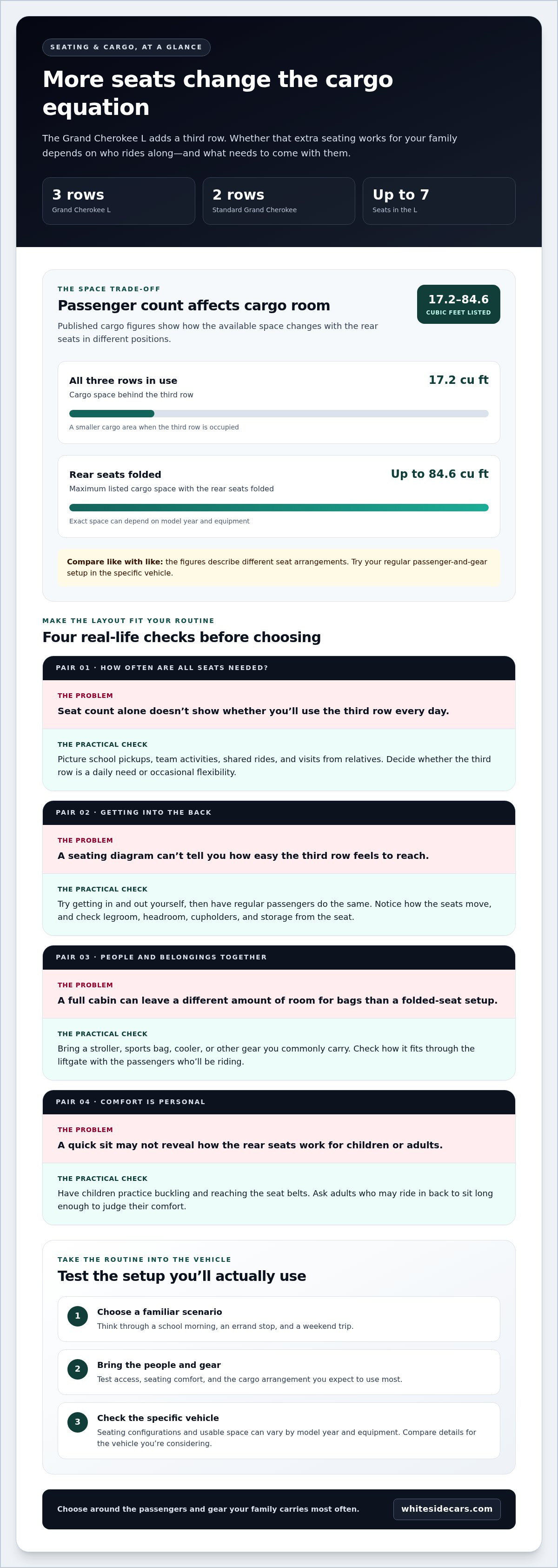
Look beyond the seat count, too. The Grand Cherokee L offers 17.2 cubic feet of cargo space behind the third row, with up to 84.6 cubic feet when the rear seats are folded. These figures help you compare layouts, but sitting in each row and trying your usual family gear will show how the space works for your routine.
This guide explains what sets the three-row model apart, which specifications and features to compare, and what to pay attention to on a test drive, from passenger access to visibility and everyday comfort. You’ll also find practical considerations for Ohio commutes, errands, and changing weather, plus a starting point for exploring Jeep options, financing, and Mopar service at Tom Whiteside Chrysler Dodge Jeep Ram in Mount Sterling.
Key Takeaways
- The Grand Cherokee L’s third row is its key distinction from the two-row Grand Cherokee. Decide how often your household will use the extra seating.
- Compare passenger access, seating flexibility, and cargo needs in person, since configurations can vary by model year and equipment.
- Choose a jeep grand cherokee l configuration around your family’s everyday priorities, including commuting, school activities, and Ohio’s changing road conditions.
- Bring regular passengers along on a test drive. Review the seating, load your usual gear, and drive familiar routes.
- Explore Jeep options, financing support, and Mopar service with Tom Whiteside Chrysler Dodge Jeep Ram in Mount Sterling.
What makes the Jeep Grand Cherokee L different from the Grand Cherokee?
The Jeep Grand Cherokee L is the three-row version of the Grand Cherokee. Its longer wheelbase makes room for the additional row, which can be useful for regular carpools or when relatives and friends ride along. The main difference is how you can use the cabin: the L accommodates more passengers, while the standard Grand Cherokee has two rows.
Think of it as a choice about how your family uses space, not simply a question of choosing the larger vehicle. If your usual routine includes a full passenger load, the third row may be useful day after day. If extra riders are occasional, weigh that flexibility against the cargo space you need for errands and trips.
Who benefits most from a three-row Jeep SUV?
A third row can suit families coordinating school pickups, team activities, or shared rides, as well as households that often take visiting relatives out together. Picture your actual passenger patterns. If the same people will use all three rows frequently, check how they get in and out and settle into their seats. If you’d use the row only now and then, consider whether that flexibility is worth accommodating in your everyday driving routine.
Grand Cherokee L versus the two-row Grand Cherokee
The basic difference is straightforward: the Grand Cherokee L adds a third seating row, while the standard Grand Cherokee has two. The L is intended for households that need additional passenger capacity. The two-row layout may make more sense when most trips involve fewer passengers and you’d rather have a two-row SUV layout. For a model overview and historical context, see the Jeep Grand Cherokee Wikipedia entry.
Consider both people and belongings before you choose. A vehicle can fit your passengers yet feel less useful if your everyday bags, sports equipment, or groceries don’t fit comfortably with everyone aboard. Think through a typical school day, a weekend visit, and a longer drive. Which seats would be occupied? What would you bring? These scenarios can show whether the third row offers daily convenience or occasional flexibility.
- Consider how often all three rows would be occupied.
- Think about passenger access and comfort, not just the seat count.
- Balance extra seating against the cargo you usually carry.
For local shopping context, the Jeep dealership guide near Columbus introduces Tom Whiteside Chrysler Dodge Jeep Ram in Mount Sterling, a resource for exploring Jeep options. Start with your household’s actual needs, whether that means a third row for daily use or occasional flexibility.
How the Grand Cherokee L's seating and space fit everyday family life
A three-row layout can adapt to changing passenger needs, from carrying the usual household on a school morning to bringing grandparents or teammates along for a weekend outing. That flexibility works best when the seats suit your passengers and leave enough room for the things you regularly bring. The jeep grand cherokee l is listed with seating for up to seven, but seating capacity and configurations can vary by model year and equipment. Compare the details for the specific vehicle you’re considering.
Use your routine to guide the decision. A central Ohio school run may mean backpacks and sports gear alongside passengers; errands could call for grocery space, while a weekend trip might add luggage or a stroller. Consider how often all seats will be occupied, not just how many seats are available.
Assessing third-row access and passenger comfort
Try getting into and out of the third row yourself, then let the people who’ll ride there most often do the same. Notice how the seats move to allow access, whether the process feels manageable, and how much room passengers have once seated. Check legroom and headroom in the actual seating positions, and see whether nearby cupholders or storage are convenient. A short sit can reveal more than a seating diagram.
Also consider how passengers will share the cabin. If children will use the rear seats, practice buckling in and reaching the seat belts. If adults may ride there, have them sit long enough to judge their own comfort. For family-vehicle research beyond the seating layout, the NHTSA safety ratings and vehicle information for the 2024 Jeep Grand Cherokee L provides official information for that model year. Use model-year-specific information when reviewing a different vehicle.
Balancing passengers and cargo
Passenger count changes the cargo picture. With all three rows in use, you’ll have a different amount of room for bags than with the rear seats folded. Published figures list 17.2 cubic feet behind the third row and up to 84.6 cubic feet with the rear seats folded. The exact configuration and usable space can depend on model year and equipment. Treat dimensions as a helpful reference, then see how your belongings fit.
Bring a realistic load to your evaluation, such as the stroller, sports bag, or cooler you commonly carry. Check how easily items fit through the liftgate and whether the remaining space suits the passengers who’ll be riding. If you regularly carry a full cabin, prioritize that setup rather than judging cargo room with seats folded. If you fold a row often, try that process, too.
- Check passenger access and comfort with the people who’ll use each row.
- Picture a school run, an errand stop, and a weekend trip.
- Test the seating and cargo arrangement you expect to use most.
These practical checks can help you decide whether the third row suits your household’s schedule. To explore Jeep options locally, view Jeep inventory at Tom Whiteside Chrysler Dodge Jeep Ram and compare the details that matter to you.
What to compare before choosing a Grand Cherokee L in Ohio
The right configuration depends on what you ask your SUV to do. A family that regularly carries several passengers may prioritize seating access and comfort, while a household that usually drives with fewer people may care more about cargo flexibility or particular convenience features. For the jeep grand cherokee l, compare the model year and vehicle configuration you’re considering, since equipment and available options can change.
Ohio driving adds practical questions. Consider weekday commuting, school activities, parking and maneuvering around town, and the seasonal road conditions you encounter. Evaluate your own routes and preferences rather than making assumptions about what a particular configuration can handle.
Which features matter for your routine?
Start with essentials: features that support comfort, visibility, and ease of use for the people who’ll share the vehicle. Separate those from preferences that would be nice but won’t affect most trips. Think about who drives, how long your typical commute lasts, and whether family members regularly adjust seats or use the vehicle’s controls. Compare equipment by model year and configuration, since availability can differ.
A feature earns a place on your list if it solves a real need. For example, consider whether your regular school and activity runs call for a particular cabin convenience, or whether simpler equipment would serve just as well. Verify the features on the specific vehicle rather than assuming every Grand Cherokee L includes the same setup.
How to compare a Grand Cherokee L with other SUVs
Use the same household and daily routine to assess every SUV you consider. Try accessing the third row, sit in the seats you expect to use, and see how cargo space changes with different seat arrangements. Also compare how easy each vehicle feels to drive and park on familiar roads. A Forbes review of seven-passenger SUVs can provide broader context, but your passenger and cargo needs should guide the choice.
Compare third-row access, passenger comfort, cargo flexibility, everyday usability, and the features you’ll genuinely use before selecting a configuration.
| Household priority | What to compare | Practical question |
|---|---|---|
| Frequent passengers | Third-row access and comfort | Can regular riders get in, settle in, and travel comfortably? |
| Changing passenger needs | Seating flexibility | How easily can the cabin adapt for a full load or a smaller group? |
| Regular gear or luggage | Cargo use with seats occupied or folded | Does your typical load fit in the arrangement you’ll use most? |
| Ohio daily driving | Must-have comfort and convenience features | Which options matter on your commute and family errands? |
Once you’ve narrowed down what matters, review the 2026 Jeep financing guide to learn about payment considerations. You can also explore Jeep options at Tom Whiteside Chrysler Dodge Jeep Ram as you compare vehicles and financing options.
How to evaluate a Grand Cherokee L on a Mount Sterling-area test drive
A useful test drive is more than a loop around the block. It’s a chance to see whether the vehicle’s seating, cargo layout, controls, and road manners match your household’s everyday routine. Before visiting, write down who usually rides along, what you carry, and where you drive around Mount Sterling or central Ohio. Bring family members who regularly use the passenger seats so they can offer their perspective.
Follow a simple sequence, and take time with each step:
- Confirm your priorities. Note typical passenger counts, regular cargo, and features that matter to your drivers.
- Explore the cabin. Try each row, adjust the seats, and check how passengers enter and exit.
- Check your cargo setup. See how your usual bags or gear fit with the seats arranged as you’d use them.
- Drive familiar roads. Evaluate visibility, controls, maneuverability, and ride comfort on routes similar to your commute or errands.
A simple test-drive checklist for families
Bring household members who’ll regularly ride in the Jeep Grand Cherokee L, and have each person try their usual seat. If you use a child safety seat, bring it along to assess placement and access. Practice folding or adjusting seats as applicable, then check sightlines, mirror use, and how easily you can reach the controls. A quiet street and a busier stretch can reveal different things about everyday comfort and handling.
Keep your observations specific. Is it easy to see around you when backing up? Can the driver reach frequently used controls without distraction? Does the vehicle feel comfortable over the kinds of roads you regularly travel? Focus on what you experience rather than assuming a feature will suit you based on its description.
Questions to resolve before choosing a configuration
Before you arrive, list your most frequent passenger and cargo situations, such as a full carpool, a routine grocery run, or a weekend with extra bags. Compare those needs with the vehicle’s current model-year and equipment information. During your visit, note any vehicle-specific questions that remain, including how a feature works or how the cabin can be arranged for your routine.
Ohio weather changes through the year, so consider what your routes are like in rain, snow, or colder conditions. During the drive, notice your view of the road, how the vehicle responds to ordinary turns and stops, and whether the cabin feels comfortable to your family. A test drive can help you judge your experience, but it shouldn’t be treated as a promise of performance in every condition.
After the drive, compare notes. Which seats felt practical? Did the cargo area work with the passengers aboard? Were the controls intuitive for the people who’ll drive? These answers can help distinguish a configuration that looks appealing from one that fits your household.
Ready to put your checklist to use? Explore Jeep options at Tom Whiteside Chrysler Dodge Jeep Ram and take a considered next step.
Explore Jeep Grand Cherokee L options with a local dealership
Once you’ve identified what your household needs from a three-row SUV, compare vehicle options against your priorities. Tom Whiteside Chrysler Dodge Jeep Ram is a Mount Sterling dealership serving shoppers across central Ohio, including Columbus-area communities. Explore the dealership’s Jeep inventory and compare each vehicle’s seating, equipment, and cargo arrangement with your needs.
A dealership visit can bring your research into focus. Compare a vehicle’s actual seating, equipment, and cargo arrangement with the notes you made about your family’s routine. If you’re weighing how to move forward financially, on-site financing support lets you discuss options as part of your shopping process. Take the time you need to understand the vehicle and decide on next steps that feel comfortable.
What to bring to a dealership visit
A short preparation list helps keep the visit focused on what matters, whether you’re comparing SUVs for daily family use or just beginning to explore.
- A list of passenger, cargo, and feature priorities, including which seats your household expects to use most.
- Basic information about your trade-in vehicle if you’re considering trading it.
- Family members who regularly ride in the third row, so they can take part in evaluating access and comfort.
- Questions about the equipment on a vehicle you’re considering, based on its current model-year information.
These details make it easier to discuss your needs clearly and compare options thoughtfully. You don’t need to arrive with every decision made. A visit is an opportunity to look, sit in the vehicle, and talk through what you’re still weighing.
Support beyond the initial purchase
Your relationship with a vehicle continues after you choose it. Tom Whiteside Chrysler Dodge Jeep Ram offers Mopar service and genuine parts for Jeep vehicles, providing a local place for maintenance and parts needs over time. Keeping ownership details and maintenance questions organized can help you have more informed conversations as your needs evolve.
For additional local shopping context, the Jeep dealership serving Columbus guide offers a closer look at Tom Whiteside Chrysler Dodge Jeep Ram in Mount Sterling. Whether you’re ready to compare vehicles in person or are still gathering information, explore Jeep options, bring your questions, and decide what feels like the right next step.
Take the next step at your own pace
The best family vehicle is one that fits the way your household moves now while leaving room for plans to change. Before deciding, consider what you learned from sitting in the seats and imagining your everyday routines. A clear sense of your priorities can make the next conversation more useful, whether you’re ready to compare a jeep grand cherokee l in person or are still weighing your options.
Tom Whiteside Chrysler Dodge Jeep Ram offers new Jeep vehicles, on-site financing support, and Mopar service with genuine parts. Explore the options, bring your questions, and choose a pace that feels comfortable for your family.
Explore Jeep options with the Tom Whiteside team and take a confident next step toward finding a vehicle that feels right for the road ahead.
Frequently Asked Questions
How many people can the Jeep Grand Cherokee L seat?
The Jeep Grand Cherokee L seats up to seven people, though the exact seating arrangement can depend on model year and equipment. Count the driver and every passenger when planning, then consider who will use each row. For example, a household might reserve the third row for children or occasional guests while keeping the second row available for regular riders. Check the specific vehicle’s configuration before comparing.
Is the Jeep Grand Cherokee L different from the regular Grand Cherokee?
Yes. The Grand Cherokee L adds a third seating row, while the regular Grand Cherokee has two. That extra row can change how you plan passenger space and everyday loading. If you often carry a full group, consider how everyone’s belongings fit alongside them. If most drives involve fewer passengers, compare how each layout suits your typical use instead of assuming the larger cabin is automatically a better fit.
Can adults sit comfortably in the third row of a Grand Cherokee L?
Some adults may find the third row suitable for certain trips, but comfort depends on the passenger and the specific vehicle’s interior configuration. Have the adults who may ride there sit in the actual vehicle and check legroom, headroom, seat position, and ease of entry. For a longer drive, consider how the seat feels after more than a quick showroom sit. Their firsthand judgment is the best guide.
Does the Grand Cherokee L have enough cargo space for family trips?
It can, depending on how many passengers are aboard and what you’re bringing. With more seats occupied, there’s less flexibility to fold seats for bulky items. A family packing overnight bags, a stroller, or sports equipment should see how those items fit in the expected passenger arrangement. Try loading your typical gear, and check whether the liftgate opening and cargo floor work for the items you carry most often.
Is four-wheel drive available on the 2026 Jeep Grand Cherokee L?
Yes, four-wheel drive is available on the 2026 Jeep Grand Cherokee L, though drivetrains can depend on the vehicle’s configuration. Compare the drivetrain shown for the specific model you’re considering, rather than relying on general model descriptions. If you’re weighing it for Ohio’s changing seasons, think about your regular routes and driving needs, too. Four-wheel drive doesn’t replace careful driving in challenging road conditions.
What should I check during a Grand Cherokee L test drive?
Check whether the driver’s seat, mirrors, and controls feel easy to adjust, then pay attention to visibility and how the vehicle handles turns and parking. Listen for cabin noise and notice ride comfort on roads similar to your daily routes. If you regularly carry passengers, bring them along so they can assess their seats. A brief drive through both open and tighter spaces can help you judge everyday maneuverability.
Can I finance a Jeep Grand Cherokee L near Columbus, Ohio?
Yes. Tom Whiteside Chrysler Dodge Jeep Ram in Mount Sterling offers on-site vehicle financing support for shoppers considering a Jeep. The dealership serves Columbus-area communities including Grove City, Dublin, Groveport, Hilliard, Canal Winchester, Ashville, Orient, Circleville, Chillicothe, London, Washington Court House, and Delaware. You can explore Jeep options and discuss financing as you decide what works for your plans.


