
What if the right jeep wrangler lease isn’t the one with the lowest monthly payment, but the one that fits how far you drive and how long you plan to keep your next vehicle? Mileage limits, upfront costs, and end-of-lease responsibilities can matter just as much as the payment. Understanding those details helps you compare offers based on the full agreement, not one number.
This guide explains the key parts of a Wrangler lease, how leasing compares with buying, and what to consider before choosing either path. You’ll also find practical ways to estimate annual mileage and prepare for a conversation about Jeep options and financing.
Whether you’re interested in a new Wrangler for a set period or want to work toward long-term ownership, there’s no single answer for every driver. Tom Whiteside Chrysler Dodge Jeep Ram in Mount Sterling offers new Jeep vehicles and personalized lease and financing options for central Ohio shoppers. From Columbus, Grove City, Dublin, Groveport, Hilliard, Canal Winchester, Ashville, Orient, Circleville, Chillicothe, London, Washington Court House, and Delaware, you can use this guide to clarify what you want to compare.
Key Takeaways
- Learn how lease duration, mileage, vehicle configuration, and credit factors can shape a jeep wrangler lease.
- Compare leasing and buying by considering ownership, contract limits, how often you want to change vehicles, and your long-term plans.
- Use your commuting, family travel, weather, and recreation habits in Ohio to estimate your driving needs and annual mileage.
- Prepare for a dealership conversation by outlining your priorities and expected mileage before reviewing Jeep options and financing paths.
- Explore new Jeep vehicles and personalized lease or loan options at Tom Whiteside Chrysler Dodge Jeep Ram in Mount Sterling.
Is a Jeep Wrangler lease right for your everyday driving?
A vehicle lease is a time-limited agreement that lets you use a vehicle under the conditions in a contract. You make payments during the agreed lease period and follow requirements such as a mileage allowance and vehicle-care standards. Unlike a short-term rental, a lease is a longer commitment with specific terms for the vehicle.
Leasing can suit drivers who like having a planned point to consider a different vehicle. If you prefer keeping one vehicle for many years, buying may fit better. Neither option is automatically right for every driver, so start with how you use a vehicle and what you want at the end of the payment period.
A lease suits you when its contract period, mileage terms, and vehicle-care expectations fit your real routine and ownership plans. Look beyond the advertised payment. Consider how often you drive, whether your mileage changes by season, and how long you usually keep a vehicle. A Jeep Wrangler has a distinctive place in the Jeep lineup. Readers interested in its background can explore the history of the Jeep Wrangler.
What does leasing a Jeep Wrangler mean?
With a jeep wrangler lease, you use the vehicle during an agreed contract period and follow the conditions in your lease agreement. Key terms typically include the payment schedule, contract duration, mileage allowance, and expectations for the vehicle’s condition. The written agreement sets the requirements, so review the full terms rather than judging the offer by its payment alone.
Terms vary by vehicle and agreement. A driver with a short commute and occasional weekend outings may need a different mileage allowance from someone who often takes longer trips. Think about a typical week, along with recurring busy periods, before deciding what allowance may fit.
Who might prefer leasing over buying?
Leasing may appeal to drivers who like a defined contract period and a planned opportunity to change vehicles. Buying may be more appealing if you expect to keep the same vehicle for many years and want to work toward ownership. Leasing doesn’t build vehicle ownership in the same way as purchasing, so consider what you want when the payments end.
Start with your routine, not a monthly payment. Do you drive a steady distance, or do work, family plans, and recreation make your mileage vary? Would you rather consider another vehicle on a planned schedule, or keep a familiar one for the long haul? These everyday details give you a clearer basis for comparing lease and purchase options.
Which Jeep Wrangler lease terms shape the agreement?
A lease offer is a package of terms, not just a monthly payment. Contract duration sets how long you agree to use the vehicle, while the mileage allowance defines the distance included over that period. The Wrangler’s configuration and credit factors can also affect the terms presented to you. Since agreements differ, use the written contract as your reference.
Compare the full agreement, because a low advertised payment doesn’t tell you the complete cost or conditions of a lease. An offer may show a payment alongside an amount due at signing, a mileage limit, and other conditions. Fees, taxes, and upfront amounts depend on the specific offer and contract. Review them together to understand the payment and the responsibilities you’re accepting.
How do mileage allowance and driving habits affect a lease?
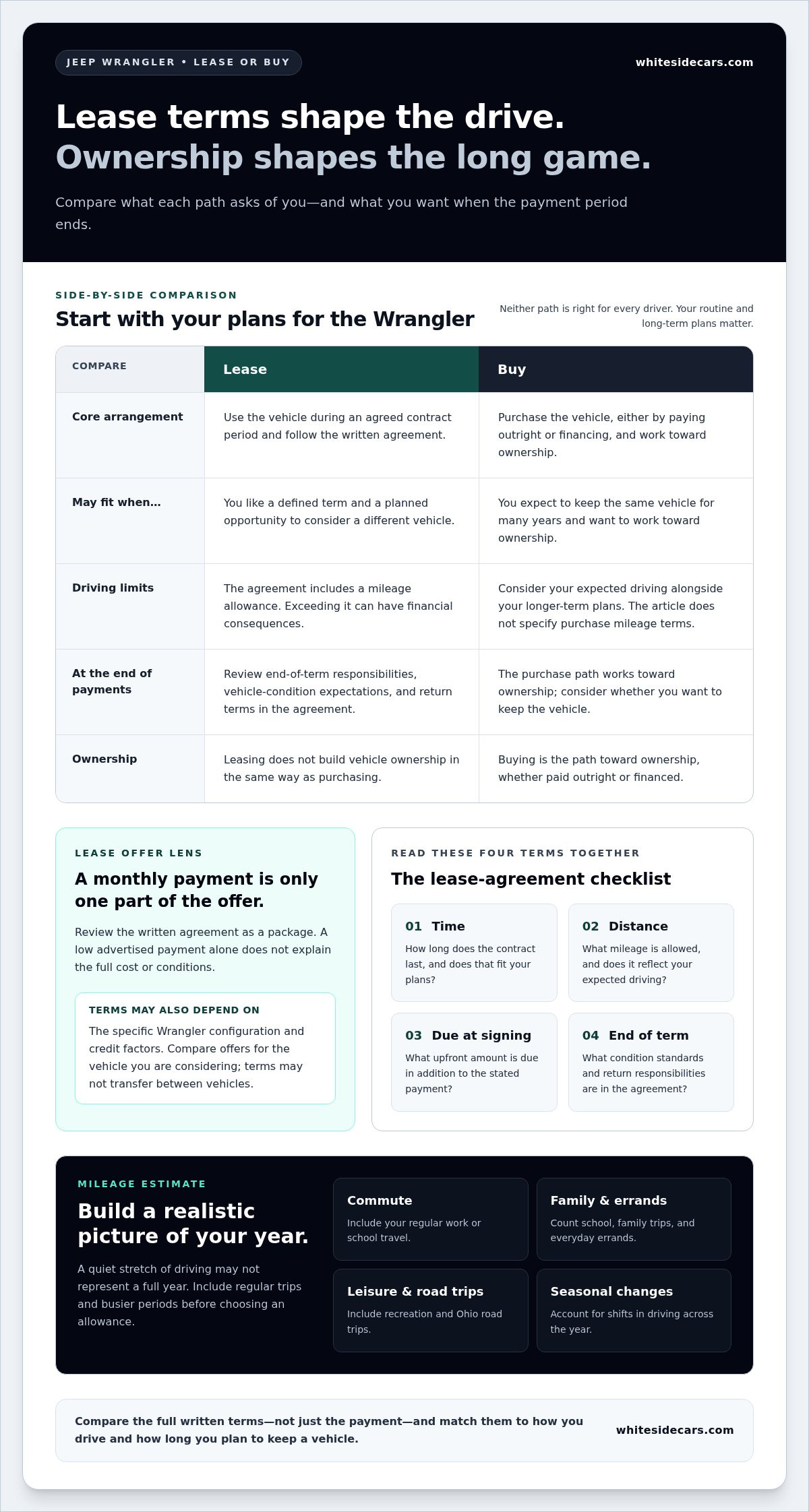
Estimate your annual driving before choosing a mileage allowance. Include commuting, school or family trips, errands, and leisure travel, then account for Ohio road trips and seasonal changes. A quiet stretch of driving may not represent a full year. Exceeding the mileage allowance in your contract can have financial consequences, so a realistic estimate matters.
What should you review in a Wrangler lease offer?
Read the offer and agreement together. Compare the contract length, mileage allowance, amount due at signing, and stated payment. Then review vehicle-condition expectations and end-of-term responsibilities. These terms explain how the agreement works beyond the monthly figure. The dealership’s Jeep financing guide offers related context on comparing lease and loan paths.
It can help to make a simple comparison for each offer you’re considering:
- Time: How long does the contract last, and does that fit your plans?
- Distance: What mileage is allowed, and does it reflect your expected driving?
- Upfront amount: What is due at signing in addition to the stated payment?
- End-of-term terms: What condition standards and return responsibilities appear in the agreement?
Credit factors and vehicle configuration may influence an offer, so compare agreements for the specific Wrangler you’re considering. Don’t assume terms transfer from one vehicle to another. For broader context, Ohio’s motor vehicle leasing dealer regulations address dealer requirements, which are separate from the payment and mileage terms in an individual contract.
To review Jeep options and lease financing, explore Jeep options and lease financing with Tom Whiteside Chrysler Dodge Jeep Ram.
Jeep Wrangler lease vs. buy: which path fits your plans?
The choice depends on what you want from the vehicle over time. Leasing gives you use of a Wrangler for a defined contract period, with limits and responsibilities set by the agreement. Buying is the path toward ownership, whether you pay outright or finance the purchase. A lease does not build ownership in the same way as a purchase, so consider what you want at the end of the payment period.
Neither option is automatically less expensive. The financial picture depends on the specific agreement, how you use the vehicle, and how long you keep it. Start by comparing the practical differences:
| Consideration | Leasing | Buying |
|---|---|---|
| Ownership | You use the vehicle under the lease contract; payments don't build ownership in the same way as a purchase. | You purchase the vehicle, building toward ownership if you finance it. |
| Contract limits | The agreement includes terms such as a mileage allowance and vehicle-condition expectations. | There is no lease mileage allowance; use and upkeep remain your responsibility. |
| Vehicle changes | A defined term can give you a planned point to consider another vehicle. | You decide how long to keep the vehicle and when to consider a change. |
| Long-term plans | May suit drivers who prefer a set contract period over long-term ownership. | May suit drivers who want to keep one vehicle for many years. |
When could leasing make more sense?
A lease may fit if you value a defined term and like planning for a vehicle change at its conclusion. A predictable driving routine can also make it easier to judge whether the agreement’s mileage allowance suits you. If you enjoy considering newer vehicles on a schedule, leasing may align with that preference. Vehicle choice, credit factors, and contract terms shape each offer, so don’t assume all drivers receive identical terms or payments.
When could buying be a better fit?
Buying may be a stronger match if you expect to keep your Wrangler for many years and want to work toward owning it. It can also suit drivers who don’t want a lease mileage allowance shaping their use. Ownership comes with its own financial and care responsibilities. Weigh the freedom you value against the actual purchase and lease terms instead of relying on a general rule about which option costs less.
For Ohio-specific legal context, the Ohio Revised Code for motor vehicle leasing covers motor vehicle sales and leasing provisions. Your individual agreement is the place to review the terms of your transaction. A useful next step is comparing purchase and lease paths for the Wrangler you’re considering. Tom Whiteside Chrysler Dodge Jeep Ram offers personalized vehicle financing, including lease and loan options, to help central Ohio shoppers compare alternatives. Explore Jeep options and financing as you consider which path fits your plans.
How to decide if a Wrangler lease fits life in Ohio
A useful lease decision starts with an honest picture of how a Wrangler would fit your everyday life. In Ohio, that may include a regular commute, family travel, winter routines, and recreational drives. Work through the steps below before comparing offers, so your mileage estimate and vehicle priorities reflect your real plans.
Build a realistic mileage and use estimate
Use recent driving patterns as your baseline, not an unusually quiet week or an idealized schedule. Add your commute from Mount Sterling or nearby communities, Columbus-area travel, regular family errands, and recurring weekend trips. Consider whether seasonal changes or planned recreation could add miles. This estimate gives you a more useful starting point for judging a lease’s mileage allowance.
Match the vehicle to your day-to-day needs
List who usually rides with you, what you carry, how you commute, and which recreational activities shape your plans. Then compare those needs with the Wrangler configuration you’re considering. Review current model-year specifications for the features that matter to your routine, and assess each lease offer on its own terms. Don’t assume every configuration or feature is included with every offer.
Use this decision process to turn your notes into a clear comparison:
- Estimate annual mileage. Review recent driving and include commuting, family trips, Ohio road travel, and weekend recreation. If your schedule changes by season, account for those shifts rather than relying on an average week alone.
- Describe your daily use. Note typical passengers, cargo, parking needs, and commute patterns. Think through a normal weekday as well as a busy weekend, so your priorities reflect more than one kind of trip.
- Identify weather-related routines. Consider how changing Ohio weather affects your plans, including whether winter conditions alter your commute or travel habits. Focus on your own routine and the vehicle specifications you want to compare.
- Prioritize features and configuration. Separate must-haves from preferences, then review the current specifications for the Wrangler model year and configuration you’re evaluating. This helps you compare vehicles on practical fit, not just appearance or an advertised payment.
- Check the lease against your notes. Compare the agreement’s mileage allowance and other terms with your estimated use and vehicle priorities. If the contract assumptions don’t match your likely routine, reconsider the fit before moving forward.
These steps can help you decide whether a jeep wrangler lease fits your driving habits or whether another path deserves a closer look. Once you’ve outlined your mileage and needs, you’ll be better prepared to compare Jeep options and their terms.
Explore the dealership’s Jeep options and use your checklist to guide a focused conversation with Tom Whiteside Chrysler Dodge Jeep Ram.
Explore Jeep Wrangler lease options with Tom Whiteside
A useful lease conversation can start with a few notes about your driving and what you want from your next vehicle. Tom Whiteside Chrysler Dodge Jeep Ram in Mount Sterling offers new Jeep vehicles and personalized lease and loan options through its finance team. Outline your needs, review Jeep options, and compare financing paths with your plans in mind.
Before exploring a specific jeep wrangler lease, consider what would make the vehicle work for you. Think about your expected annual mileage, typical passengers and cargo, and how long you’d like to keep your next vehicle. Whether you’re coming from Mount Sterling or communities such as Columbus, Grove City, Dublin, Groveport, Hilliard, Canal Winchester, Ashville, Orient, Circleville, Chillicothe, London, Washington Court House, or Delaware, those details can keep the conversation practical and focused on your priorities.
What information helps make a lease discussion useful?
Bring a realistic annual mileage estimate, a short list of vehicle needs, and a comfortable budget range. It can also help to note questions about contract duration, the amount due at signing, and what the agreement says about end-of-term choices. This preparation makes it easier to compare the complete terms instead of judging an offer by one payment figure.
- Driving estimate: Include commuting, regular errands, family travel, and leisure trips.
- Vehicle priorities: Identify the passenger, cargo, and feature needs that matter most to your routine.
- Financing questions: Write down what you want to understand about lease and loan terms, including upfront amounts and contract length.
- Ownership preference: Consider whether you prefer a defined vehicle-change schedule or the possibility of keeping one vehicle long term.
With those points in hand, compare a proposed agreement with your mileage estimate and ownership preference. If a term doesn’t line up with your routine, include that in your comparison. The goal is to understand the whole arrangement, not to rush toward a decision based on one number.
What are the next steps for local shoppers?
Start by reviewing Jeep options, then bring your priorities to a financing conversation. The finance team can discuss personalized lease and purchase paths to help you consider which structure matches your plans. For readers traveling from the Columbus area, the Jeep dealership near Columbus guide offers local context for exploring the Mount Sterling dealership.
You don’t need every detail decided before you begin. Arriving with your mileage estimate, vehicle priorities, and questions gives you a useful foundation for reviewing terms and comparing options at your own pace. Whether leasing or buying seems like the better fit, use the conversation to understand the available paths and choose what works for your everyday driving.
Start exploring Jeep options and take the next step toward a Wrangler that fits your needs.
Make your next Wrangler decision with confidence
Your next step doesn’t have to be a commitment. Use the priorities you’ve identified to start a focused conversation about what would make a lease or purchase work for you. A jeep wrangler lease is worth exploring when its terms align with your driving plans and the kind of vehicle ownership experience you want. If your priorities point elsewhere, comparing paths can help clarify your options.
Bring your mileage estimate, preferred vehicle needs, and questions about the agreement. Take time to understand the options in front of you. A thoughtful decision starts with information, not pressure.
Tom Whiteside Chrysler Dodge Jeep Ram offers new Jeep vehicles at its Mount Sterling dealership, along with personalized lease and loan options through its finance department. Whether you’re ready to review Jeep options or still weighing your plans, explore Jeep options and discuss your lease plans with Tom Whiteside. Start with your questions and compare the terms at your own pace.
Frequently Asked Questions
Is leasing a Jeep Wrangler worth it?
It can be worthwhile if the lease terms fit your driving needs and you value a planned vehicle change over building toward ownership. A driver with consistent annual mileage who prefers changing vehicles after a set period may appreciate the structure. If you expect to keep a Wrangler for many years, buying may align better with your plans. Compare complete agreements with your expected use before deciding.
Can you lease a Jeep Wrangler for a short period?
Lease duration is set by the specific offer and contract, so a shorter term depends on the options for the vehicle you’re considering. Ending a lease early isn’t necessarily the same as choosing a short lease, and the agreement may outline financial consequences for early termination. Before signing, compare the contract duration and early-exit terms with how long you expect to need the vehicle.
What happens if you go over the mileage on a Jeep lease?
Going over the contracted mileage allowance can lead to additional charges, with the calculation and terms set by your agreement. Keep an eye on the odometer during the lease rather than waiting until return to estimate the difference. If your driving plans change, review the contract and discuss your options with the leasing party before exceeding the allowance. The written agreement determines the applicable terms.
Can you buy a Jeep Wrangler at the end of a lease?
You may be able to purchase the Wrangler at lease end if your agreement includes a purchase option and you follow its process. Review the contract for purchase terms, timing, and conditions, then compare that choice with returning the vehicle or moving to another one. If buying the Wrangler matters to you from the start, include that preference in your financing discussion before signing.
Do you need good credit to lease a Jeep Wrangler?
Credit is a factor in evaluating a lease, but there isn’t one universal credit profile or set of terms for every shopper. The financing review considers your application and the specific transaction, so an advertised offer may not reflect the terms you receive. Tom Whiteside Chrysler Dodge Jeep Ram’s finance team can discuss personalized lease and loan options with shoppers from Columbus and central Ohio.
Can you trade in a vehicle when leasing a Jeep Wrangler?
You can discuss using a vehicle you own as part of a new lease transaction, but its value and any outstanding loan balance affect how it fits into the deal. If your current vehicle is leased, review that lease’s rules before treating it as a trade. Tom Whiteside offers a KBB Instant Cash Offer for customers considering selling or trading a vehicle, which can help inform your next-step comparison.
What should you do before returning a leased Jeep Wrangler?
Before returning it, review the agreement’s mileage, condition, and end-of-term requirements. Note the odometer reading, gather any maintenance records you have, remove personal belongings, and check the cabin and storage areas. Ask how the return inspection is handled and keep copies of paperwork. If you’re in the Columbus area or nearby central Ohio, plan ahead so you have time to address questions before the contract ends.


